Two wheels up front or two at the back? What each layout does in a corner
Sunny Nine Thirty-Nine- Subject
- Choosing, fitting and buying recumbent cycles, including three-wheeled tadpole and delta trikes and two-wheel recumbents, for adult road and path riding
- Editor
- The Sunny Nine Thirty-Nine team
- Subject
- Choosing, fitting and buying recumbent cycles, including three-wheeled tadpole and delta trikes and two-wheel recumbents, for adult road and path riding
Measure the outside-to-outside distance across the two front tires on a tadpole. That number, more than any other, predicts how long the trike will hold a corner before the inside wheel goes light.
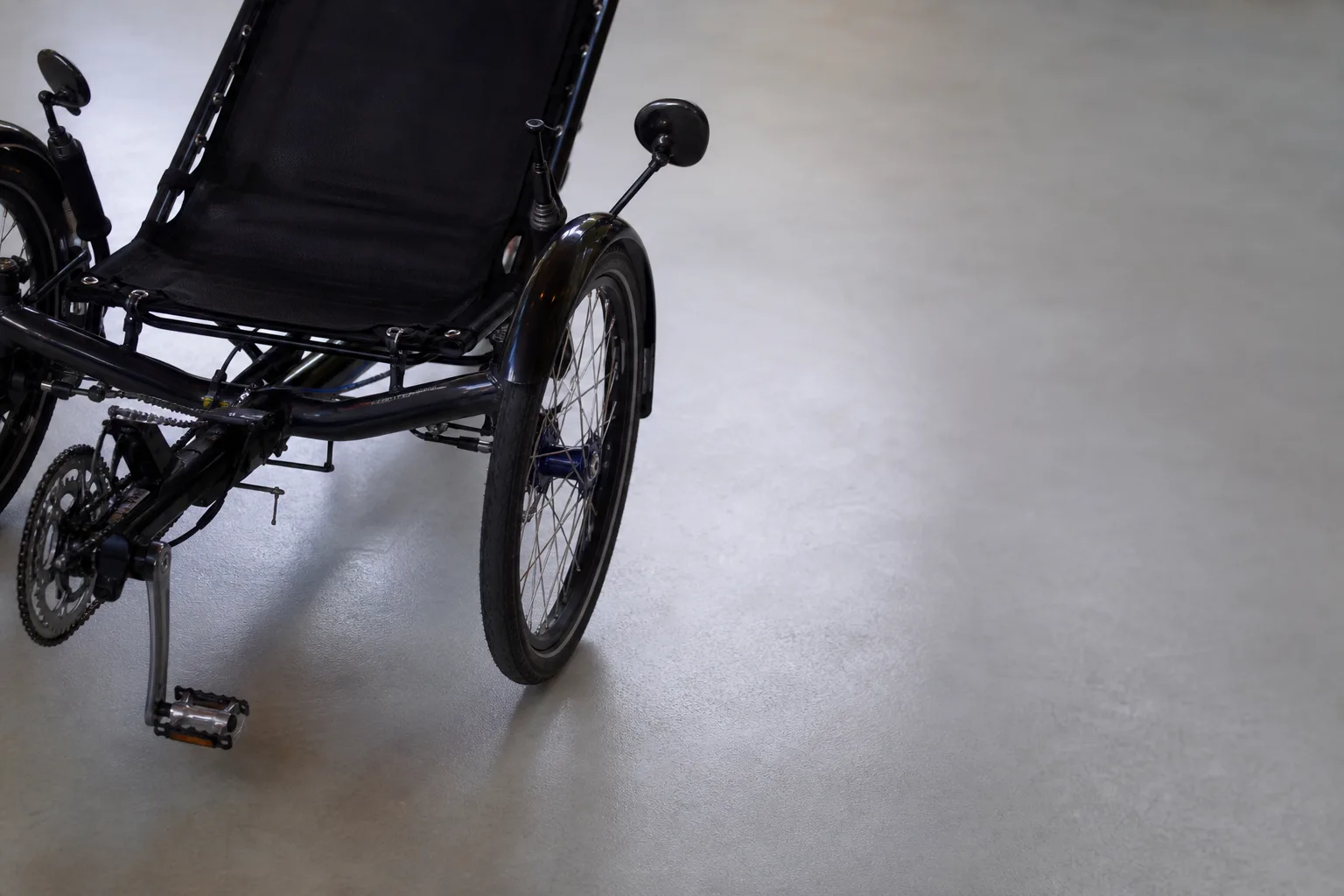
The difference between two front wheels and two rear wheels shows up first in a corner taken slightly too fast, and after that it shows up in every parking lot, every gate, every curb cut and every pannier you try to mount. Dealers will demonstrate both layouts on smooth pavement at walking pace, where the two feel more alike than they are. The checks that matter take a few minutes each, cost nothing, and can be done in the lot outside the shop with a tape measure and a willingness to look slightly odd.
What happens when the inside wheel gets light
On a tadpole, with two wheels forward and one behind, the mass sits low and slightly back, and hard cornering loads the outside front wheel while the inside front wheel gradually unweights. You feel it arrive: the steering goes light, the tire chirps, and there is usually a moment to ease off before the wheel actually leaves the ground. On a delta, with one wheel forward and two behind, the same maneuver loads the outside rear and unweights the front, and the warning is quieter because the wheel going light is the one you steer with. Neither layout is unsafe. They simply tell you different things at the limit.
Test this deliberately, at low speed, in an empty lot. Ride a tightening circle and note where the machine starts protesting, then repeat it the other way, since track width, seat position and rider weight rarely make the two directions identical. A careful reader also notes that most modern tadpoles carry a wider front track than the delta's rear track, and that width is the single biggest reason the tadpole holds a corner longer. Measure it. Outside-to-outside at the tire, on the ground.
Turning circle, gate width and the path you actually ride
Deltas usually turn tighter. A single steered front wheel with a lot of lock available can spin the machine around in something close to its own length, which matters on a rail trail with staggered gates, on a bike path that dead-ends at a bollard, and in a garage where the trike has to be turned rather than backed. Tadpoles steer two wheels through linked tie rods, and the geometry limits lock well before the tires touch the frame. Ride each one into a dead end at the shop and turn around without dismounting. That single test settles more purchase decisions than any spec sheet number.
Overall width is the other path measurement, and it is fixed. Take the widest point, add a few inches for the flag mount and mirror, and compare it against the narrowest gate you regularly pass through. If your riding involves a chained gate, a garden path or a shed door, measure the door before you measure the trike.
Seat height, curbs and getting off without a struggle
Seat height is the number that decides whether a trike works for a rider with a stiff hip or a bad knee, and it is measured from the ground to the lowest point of the seat pan. Low tadpole seats sit near ankle height and require lowering yourself in and pushing up out, using the frame or a hand on the seat back. Deltas are generally taller, sometimes close to chair height, so you swing a leg over and stand up more or less as you would from a kitchen chair. If you plan to stop often, at crossings, cafes or gates, sit in both and get out of both five times in a row before you look at price.
Height also decides how visible you are to a driver reversing out of a parking space, and whether a standard curb cut is a nonissue or a careful approach. The Consumer Product Safety Commission oversees bicycle equipment standards in the United States, and flags, reflectors and lighting are worth budgeting for on either layout, more so on a low one.
Luggage, descents and the trade you are actually making
Deltas take luggage more naturally: two rear wheels mean a rack between them, panniers that hang clear, and a load path close to the drive wheels. Tadpoles carry weight behind the seat and above the single rear wheel, which works well up to a point, and beyond it the rear end starts to feel skittish on gravel. On a steep descent the tadpole's low center of gravity and wide front track give it the calmer manners, since braking loads the two front wheels rather than pushing weight forward onto one.
Ride both down the steepest hill within reach of the shop. The answer will be obvious within a hundred yards, and it will be yours rather than anyone else's.