Thinking about a recumbent? What changes on the first hill and at the first stop sign
Sunny Nine Thirty-Nine- Subject
- Choosing, fitting and buying recumbent cycles, including three-wheeled tadpole and delta trikes and two-wheel recumbents, for adult road and path riding
- Editor
- The Sunny Nine Thirty-Nine team
- Subject
- Choosing, fitting and buying recumbent cycles, including three-wheeled tadpole and delta trikes and two-wheel recumbents, for adult road and path riding
Reclining the seat trades standing climbs and eye-level traffic presence for braking traction, all-day comfort and a fixed set of new muscle loads worth knowing before you buy.
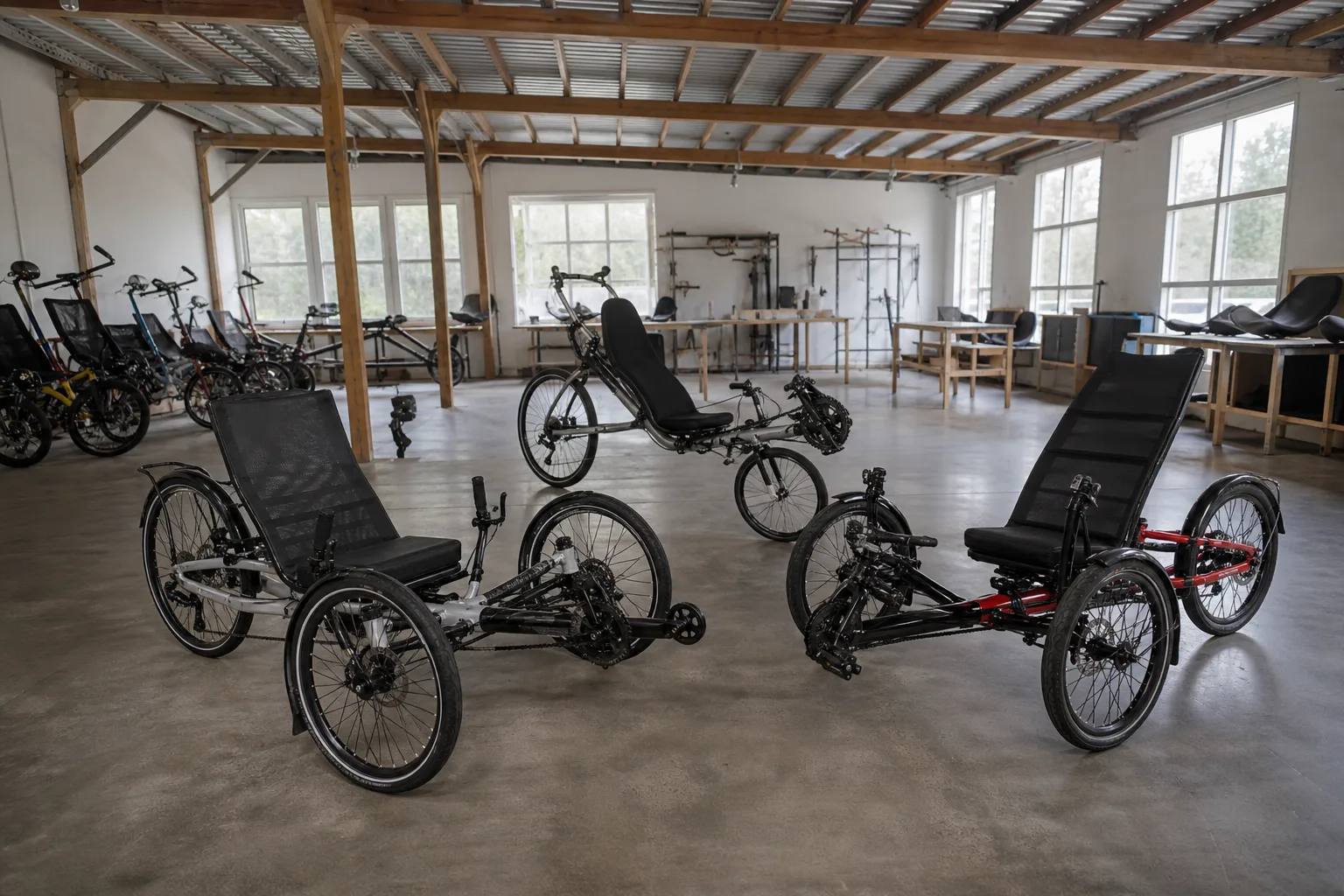
The seat is the whole argument. Once your back is supported at forty or fifty degrees off vertical and your feet are out in front of you rather than beneath you, almost every input you learned on an upright bike gets re-priced, some of it in your favor and some of it against. Nobody who tries one for twenty minutes in a parking lot finds this out, because the parking lot is flat, empty and slow. The costs and the payoffs both show up on the first real hill, at the first busy intersection, and about forty minutes into the first ride longer than a demo loop.
Climbing costs you the option to stand, and you pay for it in gears
On an upright, a steep pitch has an escape hatch: you get out of the saddle, put body weight over the pedals, and buy thirty or forty seconds of extra power that your seated legs cannot produce. Recline the seat and that hatch is welded shut. You push against the seat back instead of against gravity, which is efficient and repeatable but caps your peak output at whatever your legs alone can deliver. The practical cost is gearing. Riders coming off an upright with a 34-tooth low cog often find they want noticeably lower than that, and the money for a wider-range cassette, a smaller chainring or a mid-drive assist belongs in the purchase budget rather than in a vague plan for later.
What you get back is that the climb never ends in a collapse. Because your back is braced and your hands carry no weight, you can grind at a low cadence for a long time without the arm fatigue, hand numbness or lower-back ache that ends upright rides. Speed on the flat and the descent usually improves for the same effort, since the frontal area is smaller and you are not fighting to hold an aerodynamic position. Slow up, fast down, comfortable throughout: that is the trade, and it is worth knowing which half of it matches your local terrain before you spend.
Braking traction improves, and so does the consequence of grabbing a lever
Weight sitting low and well back means a two-wheel recumbent will not pitch you over the bars, and a three-wheeler with two wheels up front puts real load on both braked contact patches. You can use more of the front brake, more often, in the wet, with less of the fear that governs hard stops on an upright. On a tadpole with independent front brakes, though, pulling one lever harder than the other steers the machine toward that side, which is why so many trikes ship with a brake-steer-correcting geometry and why the first hundred yards of a test ride should include a firm two-handed stop. Practice that in an empty lot, deliberately, before you need it in traffic.
Your head sits at bumper height, which is a solvable visibility problem
Seat height on a road-oriented tadpole often puts your eyes somewhere between the top of a sedan's hood and the top of its trunk, which changes what a driver at a stop sign sees when they glance left. This is not an argument against the format, it is a specification you buy accessories for: a mast-mounted flag that puts orange fabric at roughly six feet, a mirror on each side so you are not turning your head to check, and a rear light that runs in daylight. Higher-seat models and delta layouts sit you up closer to upright eye level and are worth a look if most of your riding crosses driveways and side streets. The Consumer Product Safety Commission oversees the federal requirements that govern bicycle reflectors and equipment sold in the United States, and a serious lighting setup goes well past that baseline.
Budget for the visibility kit as part of the machine, not as an afterthought, because the flag, two mirrors and lights routinely add a meaningful percentage to the sticker. If the terrain near you is hilly and you are honest about not wanting to lose your average speed, an assisted recumbent trike removes the climbing objection outright at a higher purchase price and some added weight to load into a car. That is a real fork in the decision and it is better made at the shop than six months in.
The muscles that hurt first are not the ones you expect
Two things surprise nearly everyone. The first is neck strain, because a reclined seat means you are holding your head forward against gravity to see the road, and the fix is a combination of a headrest, a slightly more upright seat angle and a few weeks of adaptation. The second is hamstrings and glutes, which take a much larger share of the work when your feet are in front of you rather than below you, so early rides feel harder than the wattage suggests. Both settle within a few hundred miles. Neither is a reason to reject the format, but both argue for buying from somewhere that will let you adjust seat angle and boom length after the sale.
Three questions follow directly from all of this, and they are the ones worth resolving before a deposit: which wheel layout handles the corners you actually ride, what body measurements pin down seat angle and boom position, and what the finished, road-ready price looks like once the flag and mirrors are on it.
| Item | What it means |
|---|---|
| Lower low gear | Riders switching from an upright commonly want a lower bottom gear than they used before. A wider cassette or a smaller chainring is a purchase-time cost, not an optional upgrade. |
| Flat and downhill speed | The smaller frontal area of a reclined rider usually shows up as faster cruising for the same effort. Descents are quicker too, which makes strong brakes worth paying for. |
| No hand or arm load | Your hands steer and brake but carry no body weight, so numbness, wrist ache and shoulder fatigue mostly disappear. Ride length is limited by legs and daylight rather than by contact points. |
Low mass distribution means a hard front brake application will not pitch you forward. You can use more braking force in more conditions than an upright allows.
Independent front brakes can pull the trike toward whichever side is braked harder. Practice firm two-handed stops in an empty lot before your first ride in traffic.